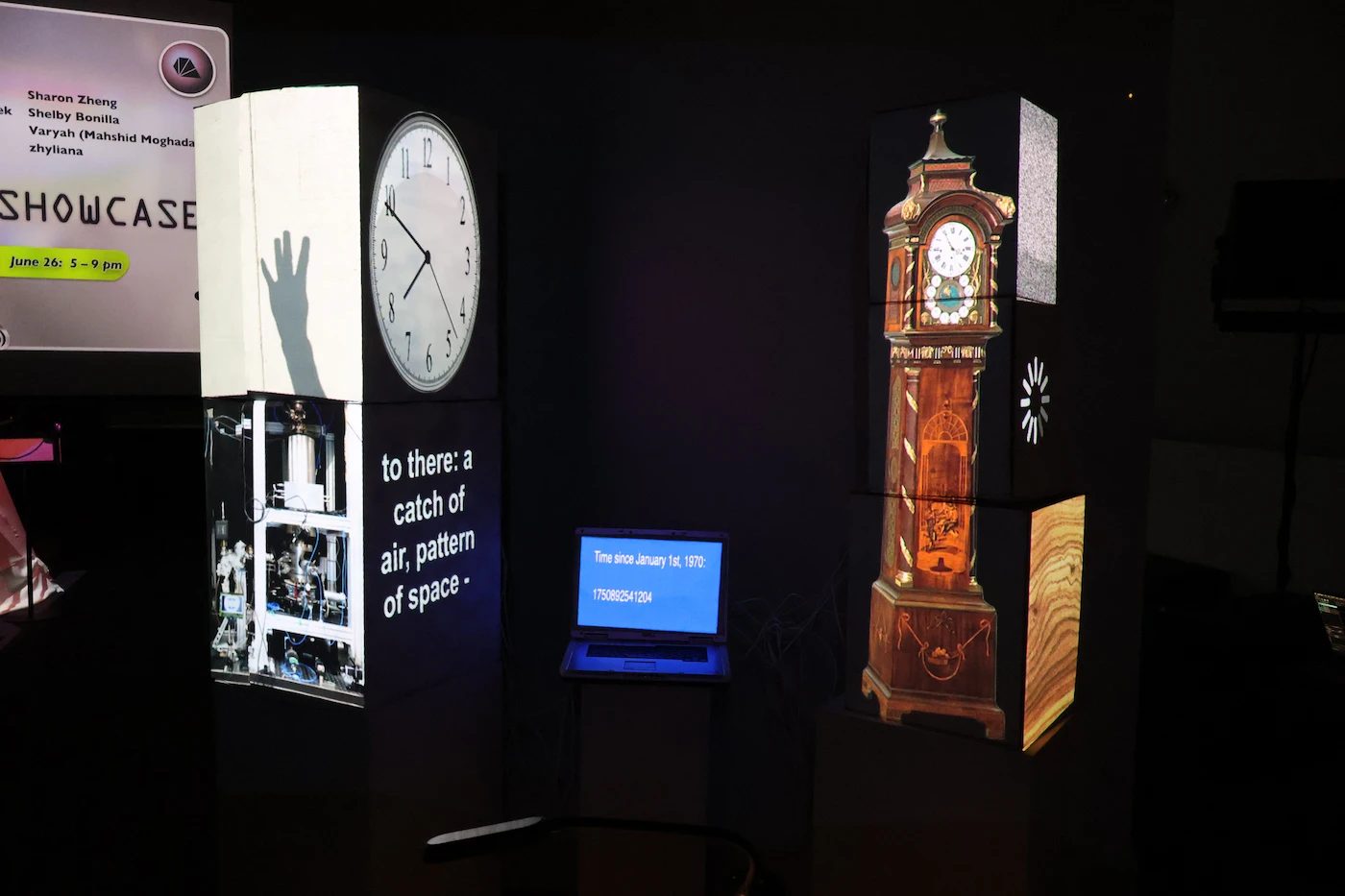
Every individual experiences time subjectively, interpreting its progression in a personal way. Our environments, through social expectations and technological systems, further influence this internal sense of time. Anthropologist Edward T. Hall identifies the United States as a monochronic culture, where people “in the market sense, [...] consume time.” This orientation emphasizes schedules, productivity, and the urgency of “getting the job done.” As digital technologies and computational systems have evolved, the cultural anxiety about efficiency and the fear of wasting time has intensified. This installation engages with the material presence of timekeeping devices to reflect on the weight our culture places on representing time. It invites viewers to consider how the devices we use to measure time shape not just our awareness, but also our sense of self. The shifting images of watches, clocks, and Unix time paired with natural materials highlight the human invention of this concept that is being projected onto the physical world. Words from Robert Creely’s poem “Time” frame the emotional reaction to the sensation of tracking time passing as it relates to existential joys, sadnesses, and curiosities. The experience encourages participants to reconsider their awareness of time and refocus phenomenologically on presence, therefore sticking to the truth as it was written by the sun, moon, and stars.